








The earth keeps some vibration going
There in your heart, and that is you;
And if the people find you can fiddle,
Why, fiddle you must, for all your life.
What do you see, a harvest of clover,
Or a meadow to walk through to the river?
The wind's in the corn; you rub your hands
For beeves hereafter ready for market;
Or else you hear the rustle of skirts
Like the girls when dancing at Little Grove.
To Cooney Potter, a pillar of dust
Or whirling leaves meant ruinous drouth;
They looked to me like Red-Head Sammy
Stepping it off to "Toor-a-Loor."
How could I till my forty acres,
Not to speak of getting more,
With a medley of horns, bassoons and piccolos
Stirred in my brain by crows and robins
And the creak of a windmill--only these?
And I never started to plow in my life
That someone did not stop in the road
And take me away to a dance or picnic.
I ended up with forty acres.
I ended up with a broken fiddle,
And a broken laugh, and a thousand memories,
And not a single regret.
--Edgar Lee Masters, Spoon River Anthology
Wednesday, September 3, 2014
Fiddler Jones

Tuesday, June 25, 2013
Would I give $10 for a Coke?
It was my first thought, but I would not really give ten dollars for a Coca-Cola. If I wanted one that badly, I'd get dressed and go to the store, where I could get a whole bunch of Cokes for ten dollars. But when I've slept nearly 12 hours, I want something bubbly, as Cliff Huxstable said.

Seems like the earlier I go to bed, the later I sleep in the morning.
There are a couple of projects that I really want to finish this year. A book of my prize poems. Several quilt tops that need quilting.
Autumn leaf
Basket
Log cabin (2)
Hands all around
Christmas star
Jacob's ladder (2)
I think I'll get dressed and go to the store.
Under the wide and starry sky,
Dig the grave and let me lie;
Glad did I live, and gladly die,
And I laid me down with a will.
This be the verse ye grave for me:
Here he lies where he longed to be;
Home is the sailor, home from sea,
And the hunter home from the hill.
Saturday, January 12, 2013
Is that sunshine I see?

*
The sun was shining on the sea,
shining with all his might;
he did his very best to make
the billows smooth and bright--
and this was odd, because it was
the middle of the night.
The moon was shining fitfully,
because she thought the sun
had got no business to be there,
after the day was done.
"It's very rude of him," she said,
"to come and spoil the fun."
The sea was wet as wet could be;
the sand was dry as dry.
You could not see a cloud, because
no cloud was in the sky.
No birds were flying overhead;
there were no birds to fly.
A Walrus and a Carpenter
were walking close at hand;
they wept like anything to see
such quantities of sand.
"If this were only cleared away,"
they said, "it would be grand!"
"If seven maids with seven mops
swept it for half a year,
do you suppose," the Walrus said,
"that they could get it clear?"
"I doubt it!" said the Carpenter,
and shed a bitter tear.
"O Oysters, come and walk with us!"
the Walrus did beseech.
"A pleasant walk, a pleasant talk,
along the briny beach!
We cannot do with more than four
to give a hand to each!"
The eldest Oyster looked at him,
but never a word he said.
The eldest Oyster looked at him
and shook his heavy head,
as if to say he did not choose
to leave the Oyster bed.
But four young Oysters hurried up,
all eager for the treat;
their clothes were brushed, their faces washed,
their shoes were clean and neat--
and this was odd because, you know,
they hadn't any feet.
Four other Oysters followed them,
and then another four,
and thick and fast they came at last,
and more, and more, and more--
all scrambling through the briny waves
and hopping to the shore.
The Walrus and the Carpenter
walked on a mile or so,
and then they rested on a rock
conveniently low;
and all the little Oysters stood
and waited in a row.
"The time has come," the Walrus said,
"to talk of many things:
of shoes, and ships, and sealing wax,
of cabbages and kings,
and why the sea is boiling hot,
and whether pigs have wings.
"A loaf of bread," the Walrus said,
"is what we chiefly need.
Pepper and vinegar besides
were very good indeed.
Now, if you're ready, Oysters dear,
we can begin to feed."
"But not on us!" the Oysters cried,
turning a little blue.
"After such kindness, that would be
a dreadful thing to do!"
"The night is fine," the Walrus said;
"do you enjoy the view?
"It was so kind of you to come,
and you are very nice."
The Carpenter said nothing but,
"Cut us another slice.
I wish you were not quite so deaf--
I've had to ask you twice."
"It seems a shame," the Walrus said,
"to play them such a trick,
after we've brought them out so far
and made them hop so quick."
The Carpenter said nothing but,
"The butter's spread too thick."
"I weep for you," the Walrus said,
"I deeply sympathize!"
With sighs and tears, he sorted out
those of the largest size,
holding a pocket-handkerchief
before his streaming eyes.
"O Oysters!" said the Carpenter,
"you've had a pleasant run.
Shall we be trotting home again?"
But answer came there none--
and this was scarcely odd, because
they'd eaten every one!
--Charles Lutwidge Dodgson
Thursday, June 7, 2012
Commentary
The world is too much with us. Late and soon,
Getting and spending, we lay waste our powers;
Little we see in Nature that is ours;
We have given our hearts away-- a sordid boon!
This sea that bares its bosom to the moon,
These winds that will be howling at all hours
And are up-gathered now like sleeping flowers--
For this, for everything, we are out of tune;
It moves us not. Great God! I'd rather be
A pagan suckled in a creed outworn,
So might I, standing on this pleasant lea,
Have glimpses that would make me less forlorn;
Have sight of Proteus rising from the sea,
Or hear old Triton blow his wreathed horn.
By William Wordsworth
*
". . .The angels keep their ancient places--
Turn but a stone and start a wing!
'Tis ye, 'tis your estrangèd faces,
That miss the many-splendored thing.
But (when so sad thou canst not sadder)
Cry--and upon thy so sore loss
Shall shine the traffic of Jacob's ladder
Pitched betwixt Heaven and Charing Cross.
Yea, in the night, my Soul, my daughter,
Cry--clinging Heaven by the hems;
And lo, Christ walking on the water,
Not of Genesareth, but Thames!"
From "In No Strange Land," by Francis Thompson
Thursday, February 23, 2012
A Poem By Edsel Ford
My dear, I have the photographs you sent
From Williamsburg and Richmond and the sea,
In which the lady with you, whose intent
No doubt was good, focused incessantly
Around and over you, at some quaint sight,
Edging you out in favor of a wave,
A bridge, a tree. And yet, dear girl, how bright
You had to be,--though edited, how brave!
Didn't she know that when you are in Boston,
You are its first attraction? And likewise
in Cuttyhunk? This ferry that you crossed on
Means nothing now, because your laughing eyes
Were not included in the snapshot, too;
I'd hoped to have three thousand miles of you.
*
I'm not sure I have it letter-perfect in my mind. I read this poem in The New Yorker many years ago, and I thought the poet was Henry Ford's son Edsel. But not so. This Edsel Ford was born in Alabama in 1928, so says Wikipedia, and grew up in Arkansas. He was a poet who published several books, but I couldn't find this particular poem online. I'm glad it stuck in my memory.
And, I'm glad to find out Ford's true identity.
Sunday, January 29, 2012
Vickie and Albert

The taller pin is nearly 5 inches high, and I've thought about using it to make a new Daddy for the Dolls' house, so he would be almost as tall as Mama. But I hate to abandon the Prince Albert idea.
Queen Victoria was a pretty good-looking little woman until she had twelve children, Albert died, and she didn't care much any more.

Saturday, June 18, 2011
Catching Up
This week I finally got a report from the Clinic on my labs: Everything was normal. Surprise!
I took all my Z-pack last week, and I feel fine. My face and throat don't hurt any more, but I still sneeze and cough, so it must be allergies. Like from cat hair, mold and dust. If someone would only clean the place up! My Amazon/Facebook friend Cindy has all this haus-frau energy; wish I could put her in my basement for about half a day.
I've got through the latest batch of alterations to Big Baby, and selected all my poems for my Semi-Complete volume. Now I just have to revise about two dozen of them.
*
Today I'm thinking of Spring. Or Fall, or Winter. Any season but Too Hot.
The Goose-Girl, by Edna St. Vincent Millay:
Spring rides no horses down the hill,
But comes on foot, a goose-girl still;
And all the loveliest things there be
Come simply, so, it seems to me.
If ever I said, in grief or pride,
I tired of honest things, I lied,
And should be cursed forevermore
With love in laces like a whore,
And neighbors cold, and friends unsteady,
And Spring on horseback like a lady.
*
I have an old china vase, with flowers and a girl feeding a goose on it, sitting on the chest in the hall. Every time I notice it, I think of Millay's poem.
Thursday, June 16, 2011
High Flight

And danced the skies on laughter-silvered wings!
Sunward I've climbed, and joined the tumbling mirth
Of sun-split clouds, and done a hundred things
You have not dreamed of--Wheeled, and soared, and swung,
High in the sunlit silence! Hovering there,
I've chased the shouting wind along, and flung
My eager craft through footless halls of air!
Up, up the long, delirious, burning blue,
I've topped the windswept heights with easy grace,
Where never lark or even eagle flew;
And while with silent, lifting mind, I've trod
The high, untrespassed sanctity of space,
Put out my hand, and touched the face of God!
By John Gillespie McGee
*
It's that kind of a day. The kind that inspired my favorite poem that I've ever written, "Splendor Before a Storm:"
Clouds with wings of gold
enfolded pale blue morning,
that a moment died, rose up white noon,
and oh bright cumulus
flung clear around
my unsuspecting stratosphere!
How can even God
behold this gleaming day, yet stay in place
while higher every mile the sky grows! I
would tumble treeward, rumbling,
"See my wonders! See Creation glowing!
Hear my thunder!"
I myself, although
no god or wing-blessed being,
must fling my senses somehow high enough
to reach and reel among
those sun-dipped fields of light,
dance there, cling there, or of sheer worship
die!
*
I trust that, when I was feeling that, I was worshiping the Creator, not the creation.
Lord, I have loved your sky,
Be it said against or for me;
Have loved it clear and high
Or low and stormy;
Till I have reeled and stumbled
From looking up too much,
And fallen and been humbled
To wear a crutch.
My love for every heaven
O'er which You, Lord, have lorded,
From number one to seven,
Should be rewarded.
It may not give me hope
That when I am translated,
My scalp may in the scope
Be constellated;
But if that seems to tend
To my undue renown,
At least it ought to send
Me up, not down.
By Robert Lee Frost (I forget the title).
*
The camera may not lie, but it's awfully inadequate on a day like this.
Sunday, August 15, 2010
The Tale of the Nancy Bell
 By W.S. Gilbert
But we'd both be blowed if we'd either be stowed
Monday, August 9, 2010
Poems for Comfort
I will arise and go now, and go to Innisfree,
And a small cabin build there of clay and wattles made;
Nine beanrows will I have there, a hive for the honeybee,
And live alone in the bee-loud glade. (W.B. Yeats, The Lake Isle of Innisfree)
*
She dwelt among the untrodden ways
Beside the banks of Dove,
A maid whom there were none to praise
And very few to love.
A violet by a mossy stone
Half-hidden from the eye;
Fair as a star, when only one
Is shining in the sky,
She lived unknown, and few could know
When Lucy ceased to be;
But she is in her grave, and oh,
The difference to me! (Wordsworth, a Lucy poem)
*
...She turned away, and with the autumn weather
Compelled my imagination many days,
Many days and many hours,
Her hair over her arms and her arms full of flowers;
And I wonder how they would have been together!
I should have lost a gesture or a pose.
Sometimes these cogitations still amaze
The troubled midnight and the noon's repose. (T.S. Eliot, La figlia che piange)
*
*
Jed came over Saturday and left Sunday. In between, he installed a new computer, but left my old setup until I get used to the new one.
*
On Friday, the Lowe's man and the Pella windows man came and measured all our windows. I only want to replace the big window unit in the living room, but the estimate was free, so I let them wander through the house measuring all the windows.
*
Saturday afternoon, while Jed was working on the computers, I went to the thrift store with Sister Ramey. She found two pretty T-shirts for me, and I found a beautiful antique bowl for myself. I know--coals to Newcastle, etc. But aside from my collection of yellow ware, I don't have enough serving bowls. Or didn't.
Saturday, July 17, 2010
One of those Frankly-My-Dear mornings
Of which I get too few. I usually wake up with the weight of the world--or of things I have to do--staring me in the face. Today, who cares? If you wash the dishes or the cat or the clothes, it just encourages them to get dirty again.
 Teresa (T.K.) Thorne, in photographs, is a cute elf. In person, she is a truly beautiful woman. Makes you think of the word Levantine. Oriental and exotic. And "nobody, not even the rain, has such small hands" (e.e. cummings). Her book, Noah's Wife, is a winner. In October, she is going to travel over all the country she wrote about in that book. (An aside: She said she started out writing science fiction, and wanting to be an astronaut.)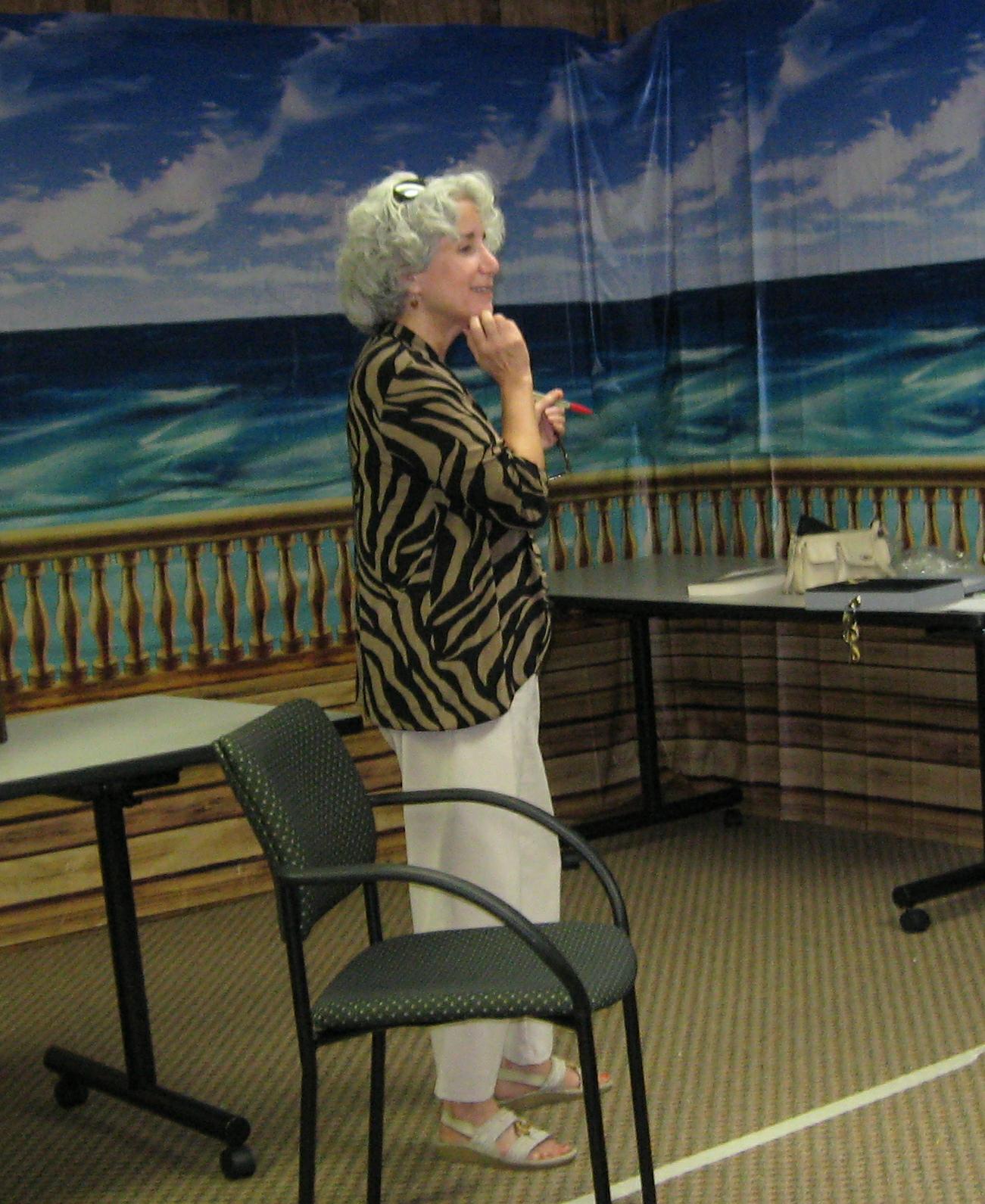
 Teresa wore ivory silk cropped pants, and Ramey was her fascinating self in a Jean-Mock-dressy top that put other T-shirts to shame. Might call it a Tea Shirt.
Friday, July 9, 2010
The Lazy, Crazy, Scorching Days of Summer
 This is a significant anniversary day, so I spent the morning outside to keep from getting the blues.
 My two crape myrtles are almost ruby red, though they just look dark pink in the photo.
 The hydrangeas have lost their pinks and blues, and are turning green and brown.
 I'm going to dry these three big 'uns, if I can find that bag of silica that I know is in the house. I tried drying one by hanging it in the closet, and it just shriveled up to about an inch and turned dark brown.
 Someday it'll be a quilt or a throw, or another abandoned project.
  Wish I had a beer and some pretzels. Or two beers and no pretzels.
 ***
Friday, June 11, 2010
A Favorite Poem

by Alfred, Lord Tennyson [1809-1892]
Sunset and evening star
And one clear call for me!
And may there be no moaning of the bar,
When I put out to sea,
But such a tide as moving seems asleep,
Too full for sound and foam,
When that which drew from out the boundless deep
Turns again home.
Twilight and evening bell,
And after that the dark!
And may there be no sadness of farewell,
When I embark;
For though from out our bourne of Time and Place
The flood may bear me far,
I hope to see my Pilot face to face
When I have crossed the bar.
***
...
Friday, October 23, 2009
Poems I Know By Heart
Shakespeare's Sonnets tell the story of his life.
#76
Why is my verse so barren of new pride,
So far from variation or quick change?
Why, with the time, do I not glance aside
To new-found methods and to compounds strange?
Why write I still all one, ever the same,
And keep invention in a noted weed,
That every word doth almost tell my name,
Showing their birth, and where they did proceed?
O know, sweet love, I always write of you,
And you and love are still my argument;
So all my best is dressing old words new,
Spending again what is already spent;
For as the sun is daily new and old,
So is my love, still telling what is told..jpg)
#94
(I don't know this one by heart, but it tells his name. It's the only one of 154 sonnets that contains all the letters of his name in order--his usual signature. All the letters of his first name are counted from the left; all the letters of his last name are counted from the right. I presented this at an Oxford Shakespeare Society convention in Atlanta or Washington DC, I forget which. The poem doesn't make much sense, except that it tells his name.) Drawing by me, from a portrait of the Earl of Oxford.
ThEy that have power to hurt and will do none,
That Do not do the thing they most do show,
Who moving others, are themselves as stone,
Unmoved, cold, And to temptation slow;
They Rightly do inherit Heaven's graces,
AnD husband nature's riches from expense;
They are the lords and Owners of their faces,
Others but stewards of their eXcellence;
The summer's flower is to the summer sweEt
Though to itself it only live aNd die;
But if that flower with base inFection meet,
The basest weed Outbraves his dignity:
For sweetest things turn sourest by theiR deeds:
Lilies that fester smell far worse than weeDs.
Saturday, September 5, 2009
For Comfort
Alas for him who never sees
The stars shine through his cypress trees;
Who hopeless lays his dead away,
Nor wakes to see the break of day
Across the mournful marbles play;
Who hath not learned, in hours of faith,
The truth to flesh and sense unknown:
That life is ever lord of death,
And love can never lose its own...
From "Snowbound," by John Greenleaf Whittier
*
We had rain again this morning. Angels' tears.Wednesday, August 19, 2009
Great (and Optimistic) Expectations
It's nice to sit here and feel books from around the country flying through the air towards me. I've ordered several from Bookins and from Amazon Marketplace. Here's a list of those that I expect to read before the end of the year, some of which I already own:
Cry To Heaven, by Anne Rice (September book club selection)
The Red Tree, Low Red Moon, and Daughter of Hounds, by Caitlin R. Kiernan
The Haunted Bookshop, by Christopher Morley
Beowulf's Children, by Larry Niven, Jerry Pournelle and Steven Barnes
Heavenly Powers, by Neil Asher Silberman
The nature of most of these titles is a bit unusual in my reading diet--vampires and grendels and things that go bumpity in the night. The Silberman book is about Judaic history and mysticism. To keep my balance, I'll probably read soothing works like Keats, Yeats and Fannie Flagg in between some of these.
A poem by me:
On Imitation (July 17, 1974)
Don't be a poet that cheats.
Don't be a sheep that bleats.
Don't copy Mr. Keats.
Don't copy Mr. Yeats.
Saturday, April 18, 2009
How Like a Winter
My poem "Letter From the Country" (page 23 of OME, posted April 13th), was inspired by a Shakespeare sonnet:
XCVII.
How like a winter hath my absence been
From thee, the pleasure of the fleeting year!
What freezings have I felt, what dark days seen,
What old December's bareness everywhere!
And yet, this time remov'd was summer's time,
The teeming autumn, big with rich increase,
Bearing the wanton burden of the prime
Like widow'd wombs after their lord's decease;
Yet this abundant issue seem'd to me
But hope of orphans, and unfather'd fruit;
For summer and his pleasures wait on thee,
And, thou away, the very birds are mute;
Or, if they sing, 't is with so dull a cheer,
That leaves look pale, dreading the winter's near.
which is one of at least a dozen that I know by heart. "What potions have I drunk of Siren tears,/ Distill'd from limbecks foul as hell within!" Reading Shakespeare's sonnets can be an education in English literature, if one studies them enough to know what they say, and what they mean.
"When in disgrace with fortune and men's eyes,
I all alone beweep my outcast state,
And trouble deaf Heaven with my bootless cries,
And look upon myself, and curse my fate;...
Wishing me like to one more rich in hope,
Featured like him, like him with friends possessed;
Desiring this man's art, and that man's scope;
With what I most enjoyed, contented least--
Yet in these thoughts, myself almost despising,
Haply I think on thee; and then my state
Like to the lark at break of day, arising
From sullen earth, sings hymns at Heaven's gate;
For thy sweet love remember'd, such wealth brings,
That then I scorn to change my state with kings."
I know of no rougher magic.
***
My poem today from OME is "People-Watching," on page 18:
People-Watching
Don’t you remember me?
It’s rude, you know, no matter what the reason,
to tuck in your chin and hurry by
and cut me
dead.
In Salem once
we piled the rocks as high as we could reach,
and never heard a cry or groan.
Wasn’t that you?
When we were moving stones for old Ramses,
someone in the quarry bumped my arm,
causing me to drop
a load on him, and I believe
he had your face.
And you—remember: when the Sirens sang,
and we bound each other to the mast,
I could have tied slip knots, and where
would you be now?
Old antagonisms don’t excuse
your corner-eyed,
hesitating glances,
as if you never saw me
in your lives.
Come, don’t hold grudges!
If I broke your bones, why,
that’s how these emporia,
these monuments and pyramids
get built.
Monday, December 8, 2008
"Nothing gold can stay..."
On November 28, I wrote about my dream of Robert Frost. One of these days I'm going to make an album of my strange, funny, crazy dreams. This is the way RF looked in the dream, only he was grinning all the time, and one of the poems I like so much.

Another of my favorite poems is too long to remember all of it. It's "Directive," and it's worth reading. "Let a guide direct you,/ Who only has at heart your getting lost."
*
And the last stanza of "Two Tramps in Mud Time" is a good motto to live by, if you're looking for one.
"...yield who will to their separation,
My object in living is to unite
My avocation and my vocation
As my two eyes make one in sight.
Only where love and need are one,
And the work is play for mortal stakes,
Is the deed ever really done
For Heaven and the future's sakes."
*
I think the cruellest thing old age can do to a body is to make him forget things like this that he remembers.
Thursday, September 20, 2007
Autumn Skies
"Well, children," as Sojourner used to begin her talks, I have to tell you:
And the firmament showeth His handiwork,
Day unto day uttereth speech, and night unto night showeth knowledge;
There is no speech nor language where their voice is not heard...

After working on my books this morning, I went to the Post Office, of course, then to the library sale to do my volunteer hours taking money, and found they had added a lot of yard sale items. I came away with one book, and a beautiful Christmas tablecloth still sealed in its original plastic cover.
Speaking of skies and books, below is a book of mine that I wouldn't part with, mainly because of the beautiful cover.

Sunday, July 22, 2007
Poem for Sunday

Lord, I have loved Your sky,
Be it said against or for me,
Have loved it clear and high,
Or low and stormy;
Till I have reeled and stumbled
From looking up too much,
And fallen and been humbled
To wear a crutch.
My love for every Heaven
O'er which You, Lord, have lorded,
From number One to Seven,
Should be rewarded.
It may not give me hope
That when I am translated
My scalp will in the cope
Be constellated.
But if that seems to tend
To my undue renown,
At least it ought to send
Me up, not down.